

✨ A Note on This Updated Post:
I originally wrote these words in 20179 but as my own journey (aka perimenopause) has changed, I realized this piece needed to evolve alongside me. Here is how I truly fuel my body in this season of life!
There are two things I get asked about more than ANYTHING else. Can you guess them?! Almost every day, I get questions about 1. my family, and 2. what I eat, so I thought I’d give a little sneak peek into how my eating has changed during perimenopause.
Seriously though, whether you’re just starting out on your fitness journey or a seasoned vet of the health world, taking a look at another person’s meal plan can be incredibly helpful!
So often we become our own worst critic, judging too harshly the tiny cheats we indulge in or feeling like we’re not doing this whole transformation thing “right.”
As we get closer to midlife and beyond, we need to choose a new approach to how we fuel our bodies. While strict calorie counting, tracking, and cutting may have gotten us to our goals before, it won’t work anymore. Trust me on this one.
Instead, we need to listen to our bodies, pay attention to how the foods we eat affect us mentally and physically, adapt based on the feedback our bodies are giving us, and most importantly, have a LOT of patience in this amazing season of life that feels like it’s constantly changing. Because it is.
Our 40s and beyond can feel drastically different from what we’re used to, and all of the changes we experience as our bodies naturally evolve can feel completely overwhelming. Here’s the deal: How we choose to fuel our bodies can make ALL the difference, and I’m sharing what I’ve discovered so you don’t have to. You’re welcome. 💕
What I Eat in a Day in Perimenopause
📝 TL;DR: Perimenopause Nutrition in 30 Seconds
If you’re short on time, here is the executive summary on how to fuel your body, balance shifting hormones, and protect your metabolism in midlife:
- •
Addition Over Deprivation: Strict calorie cutting and starvation diets destroy midlife metabolism. Focus on adding hormone-supportive nutrients rather than cutting food groups. - •
Prioritize Protein & Fiber: Aim for 0.8–1.2g of protein per pound of goal weight to fight muscle loss (sarcopenia), and 25–30g of fiber daily to bind and flush out excess circulating estrogen. - •
Love Your Gut & Liver: Estrogen is metabolized in the liver and eliminated through the gut. Support them daily with cruciferous veggies, fermented foods, healthy fats, and targeted micronutrients. - •
Take Baby Steps: Don’t overhaul your life overnight. Track your baseline and make one tiny swap a week to let your evolving body adapt sustainably.

🚀 Get the Support You Deserve:
Grab my Perimenopause Guide—it is an absolute must-have resource for navigating this transition with confidence!
When we enter the perimenopausal stage of life, we also enter a literal hormonal chaos zone. I believe that knowledge is power, so the more we understand what’s going on during this natural evolution of life, the better equipped we’ll be to know how to fuel our bodies for optimal health. To be the best CEOs of our own health.
The Perimenopausal Hormonal Shift
What happens when we enter the “hormonal chaos zone”—and how it really feels.
Mood & Mind
Brain fog, sudden anxiety, irritability, and emotional mood swings that make you feel like you aren’t in the driver’s seat.
Metabolism & Fat
A noticeable metabolic slowdown paired with stubborn, sudden belly fat that doesn’t respond to old diet tricks.
Muscle & Bone
Accelerated loss of lean muscle mass (sarcopenia) and dropping bone density as protective estrogen levels decline.
Sleep & Cycles
Unpredictable cycle changes, disrupted sleep, and 3 AM wake-ups driven by daily shifting hormone levels.
You are not crazy, you are not imagining it, and you are not doing anything wrong.
Knowledge is power—when we understand what’s shifting, we can fuel our bodies to become the best CEOs of our own health.
As I listed above, here are some of the effects of all of that hormonal chaos during perimenopause:
- Brain fog
- Mood fluctuations
- Anxiety
- Irritability
- Sleep issues
- Cycle changes
- Belly fat
- Muscle loss
- Bone density loss
- Slower metabolism
It’s a lot to navigate, for sure. And please hear me when I say this: You are not crazy. You are not imagining any of these symptoms. You are not doing anything wrong. Your hormones are shifting daily, and one of the simplest things you can do to successfully navigate all of these natural changes is how you fuel your beautifully evolving body.
🎙️ Deep-Dive Into These Conversations on the Podcast:
Ep. 93: Perimenopause 101: The “Triple Threat” Your Doctor Never Warned You About!
Focus: Metabolic intelligence, the hormonal timeline, why weight loss feels impossible, and the non-negotiable nutrition & muscle rules for midlife.

Key Food Categories to Support Hormone Balance + Metabolism
While most nutrition plans take away or restrict foods, we’re not going there. Yes, I’ll share a few things that can work against hormone balance in a bit, but I’ve found through my years of coaching women that the highest rate of success comes not from deprivation but from addition—adding in foods that can serve you and your body in the best ways possible.
Please view this as your complete-ish perimenopause nutrition guide, and yes, you’ll notice that there is some overlap, which makes it easier to incorporate these perimenopause-friendly foods in your daily nutrition plan! And as with anything important in life, begin where you are right now, make one tiny change, and once that’s a habit, make another tiny change. Small baby steps work best. Always.
Protein: Your Muscle + Metabolic Armor
Ladies, I will stand on my protein soap box as long as it takes for us to understand just how crucial consuming enough protein is for optimal health as we navigate our 40s, 50s, 60s, and beyond. Protein is the ultimate builder and repairer of pretty much everything in your body, but when it comes to perimenopause, it’s absolutely essential for building and maintaining muscle, protecting bone density, burning calories, a healthy metabolism, and insulin resistance. You might not notice it, but once you hit your 30s, you start to lose 3-8% of your muscle mass every single decade. It’s called sarcopenia, and it’s real.
I’ve found that most of us do not eat enough protein. So, how much should you be eating? Aim for .8-1.2g per lb. of goal or maintenance weight. So, if your goal or maintenance weight is 150 lbs, your protein goal is 120-180g/day. While this number might sound daunting, it can be done. If you’re not hitting your goal currently, increase your protein intake gradually.
Protein options:
- Chicken breast
- Pork loin
- Lean cuts of red meat (helps keep your iron levels stable, especially if you experience heavy cycles)
- Greek yogurt
- Cottage cheese
- Protein powders (I love protein powder because it’s a super simple way to help meet my daily protein goal, and I can take it with me anywhere)
→ Before you read any farther, please grab my guide on how to build muscle after 40 here. And yes, it’s 100% possible!
Cruciferous Vegetables: The “Estrogen Cleanup Crew”
Leafy green vegetables can help your body process and detoxify estrogen properly. They can also help ease symptoms of estrogen dominance like bloating, heavy cycles, mood swings, and so on. This type of vegetable also contains *DIM (diindolylmethane), which can help promote hormone metabolism and improve the estrogen/progesterone balance.
Cruciferous vegetable options (Aim for 1-2 servings/day):
- Broccoli
- Brussels sprouts
- Cauliflower
- Cabbage
- Kale
- Broccoli sprouts
- Collard greens
- Arugula
- Bok Choy
Fiber: The Estrogen Binder + Unsung Hero
Guys, fiber is crucial to optimal health, no matter what stage of life you’re in. If you struggle to get enough fiber in your diet, you’re not alone. The American Journal of Lifestyle Medicine found that 95% of us don’t eat enough fiber. So, beyond the usual benefits of fiber, when it comes to perimenopause, fiber is crucial. Why? It binds excess estrogen in the digestive tract for elimination (preventing recycling in the gut, which increases that hormonal chaos!), improves insulin sensitivity, stabilizes blood sugar, and supports overall gut health.
How much fiber should you be consuming daily? Aim for 25-30 grams per day, and if you’re in that 95% group, please increase your fiber intake slowly and drink lots of water. If you increase your fiber amount too quickly, your digestive system will not be happy!
Sources of fiber (some of these will help with your protein goal too!):
- Berries: Did you know that a 6 oz container of raspberries has 9 grams of fiber?!
- Flaxseed: These little fiber powerhouses also contain lignans, which are phytoestrogens that provide mild, balancing estrogen support.
- Chia seeds
- Lentils
- Beans
- Vegetables
- Oats
- Whole grains
When it comes to finding good sources of fiber for fruits and vegetables, look for the four Ss: Seeds, skins, stalks, and strings.
The Ultimate Fiber & Gut Health Routine
Why gut support and estrogen elimination go hand-in-hand during midlife.
Binds Excess Estrogen
Fiber works like a sponge in your digestive tract, trapping metabolized estrogen and ensuring it gets eliminated rather than reabsorbed into your bloodstream.
Balances the Microbiome
Dropping estrogen levels naturally reduce gut diversity. Pairing prebiotic fiber with targeted probiotics restores good bacteria, banishing bloat and soothing digestion.
Stabilizes Blood Sugar
Consistent daily fiber slows down glucose absorption, helping curb energy crashes, evening cravings, and midlife insulin resistance.
Struggling to hit your daily 25–30g of fiber or dealing with midday bloating?
Support your estrogen detox pathway, optimize digestion, and restore gut balance with my daily digestive enzyme and probiotic routine.
Healthy Fats: The Building Blocks of Hormones
Hormones (including estrogen) are literally built from dietary fat. If you chronically under-eat fat (like we were told to do in past decades), your body will lack the raw materials to make the hormones it needs. Healthy fats can also help reduce inflammation, improve cell signaling, and even help your skin look healthier.
Healthy fat choices:
- Avocado
- Olive oil
- Nuts
- Seeds
- Fatty fish (salmon, sardines)
- Eggs: Eggs contain healthy fat AND are an amazing source of protein. Recent research has found that eating five eggs a week is associated with a lower risk of Alzheimer’s disease and cognitive decline, thanks to nutrients like choline and omega-3s. Yes, please!
Fermented Foods for Gut Health
I’ve recently discovered just how important fermented foods are for gut health, especially in perimenopause. As your estrogen levels drop, your gut microbiome diversity decreases, which can cause inflammation, bloating, a slower metabolism, and mood issues (90% of serotonin is made in the gut!). Fermented foods have also been shown to help prevent estrogen-deficiency-induced bone loss and improve mood, brain fog, and insulin sensitivity.
Sources of fermented foods (Aim for one serving a day):
- Plain Greek yogurt
- Kefir
- Kimchi
- Sauerkraut
- Kombucha
- Miso
Foods for Liver Support
Estrogen is processed and metabolized in your liver, so a sluggish liver can mean any hormonal symptoms you’re experiencing can become worse. No, thank you! Thankfully, including liver-friendly foods in your meals can be quite simple.
Liver-friendly options:
- Garlic
- Onions
- Leafy greens
- Beets
- Lemon
- Other sulfur-rich foods: Get an awesome list here.
📚 Want to Go Deeper? Read More on the Blog:
Explore these companion guides on gut health, hydration, fiber, and smart fueling:
🦠 What the Gut? The Ins & Outs of Gut Health
Why gut diversity directly affects bloating, immunity, mood, and how your body eliminates toxins.
🌾 Fiber & Fitness: Impact on Transformation
How hitting 25–30g of daily soluble and insoluble fiber supports estrogen binding and keeps blood sugar steady.
💊 Micronutrients Matter: The Macro Myth Busted!
Why tracking calories/macros alone isn’t enough—and why vitamins, minerals, and nutrient density matter for hormone health.
💧 Healthy Habits: Why You Need More Water
How proper cellular hydration and electrolytes fight midlife fluid retention, curb cravings, and beat brain fog.
Micronutrients + Hydration: Expert Additions for Perimenopausal Health
In addition to the nutrition options I’ve listed above, micronutrients can up your perimenopausal health as well. As with any supplements, please talk with your healthcare provider before adding any of these to your plan.
- Bone health (Calcium + D3 + K2): As your estrogen levels drop, your bone density can decline rapidly. While protein and strength training can definitely help, an adequate calcium intake is critical. Pair your calcium supplement with Vitamin D3 and K2 to ensure the calcium is directed into the bones, not the arteries.
- Magnesium (The Calming Mineral): Magnesium is essential for over 300 biochemical reactions. It can help regulate cortisol (stress), improve sleep, and ease the muscle cramps and heart palpitations that can be common in perimenopause.
- Hydration & Electrolytes: Any shifts in your hormones can affect the fluid balance in your body. Night sweats and hot flashes can increase fluid loss. Adding electrolytes (sodium, potassium, magnesium) to your water can help rehydrate your cells, balance your hormones, and reduce brain fog.
What Foods Can Work Against Hormone Balance?
While I’m against restriction when it comes to nutrition—I don’t offer any “Never eat this” kind of advice, here are three areas where it’s good to be aware of how they can impact your body in perimenopause:
- Alcohol: Can significantly slow down liver estrogen detoxification, cause inflammation in your system, and cause sleep issues.
- High sugar/ultra-processed foods: Can worsen insulin resistance, create blood sugar spikes, and disrupt your sleep—especially when eaten near bedtime.
- Chronic undereating + starvation diets: Deprive your body of the building blocks it needs for hormone production and muscle preservation, and destroy your metabolism. If you’re using a GLP-1 and/or trying to lose weight, I actually tell women to err on the side of a little too much than too little food because it’s easier to burn fat down the road than it is to rebuild the muscle that you’re losing and any other damage that can result from undereating.
Realistic Daily Strategies for Perimenopause Nutrition
Here are some things that have worked for me, and I hope they’ll give you an idea of some healthy + easy + REALISTIC options for your nutrition plan:
- Morning Fuel: I still drink a protein shake every single morning like I’ve done for decades, and because I work out in the morning, I usually pair it with a banana.
- Everyday Protein MVP: Greek yogurt is my MVP because it’s so easy. I can grab two single servings, which give me 20g of protein. You can also replace sour cream with Greek yogurt in most recipes—that’s a super simple way to increase your protein intake. One of my new and super easy favorites is egg salad made with chopped boiled eggs, a bit of mustard, and a healthy dollop of Greek yogurt. Yum!
- Smart Treats: I do not deprive myself, and yes, I will eat cookies when I want to. Here’s the key: I typically eat a couple of cookies with a protein shake or some source of protein to stop myself from overeating and to help with digestion.
- Nighttime Awareness: When it comes to nighttime eating, I cannot eat too much sugar before bed or I sleep like crap, and I get really bad acid reflux.
- Evening Protein Catch-Up: If I haven’t met my protein goal for the day, I will pair a protein shake with a healthy carb before bed to make sure my body is being properly fueled and to hit that important goal.
- On-the-Go Starbucks Routine: I still get Starbucks quite often, but instead of my usual MDB, I choose egg white bites and oatmeal with the whole pack of nuts and half a pack of dried fruit.
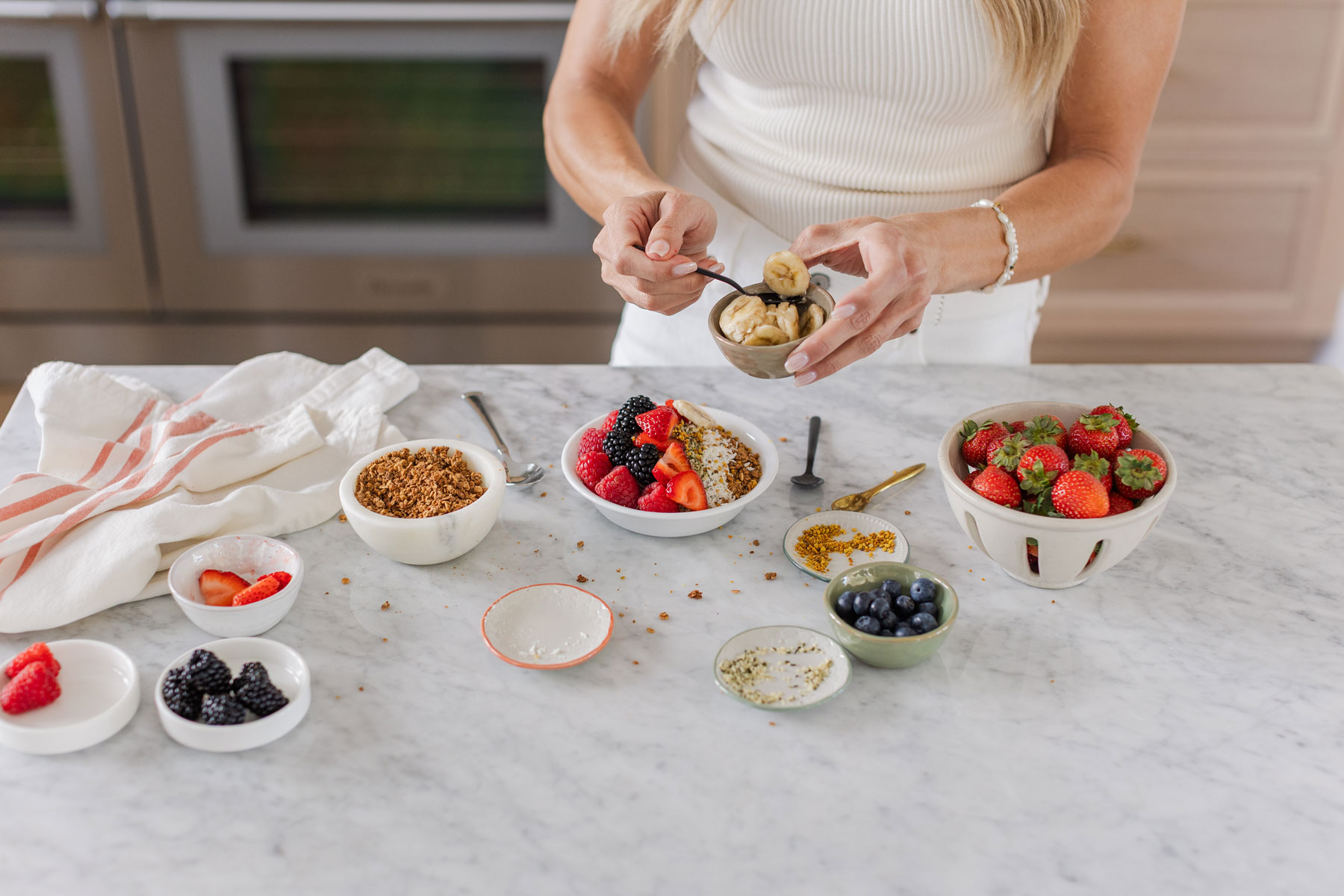
- Anytime Parfait: I love to create a nutrition-rich parfait from Greek yogurt, cottage cheese, berries, chia seeds, and granola. I can eat this any time of the day!
I know, I know. That’s a lot of information, and the last thing I want you to feel is overwhelmed. Here are four super simple tips to get you started on your own perimenopause nutrition journey that can fit right into your oh-so-real life:
Tip #1. Begin where you are right now. That’s always the best place to start. 😉
Tip #2. Track your current eating habits for a few days without changing anything to establish your baseline. You have to know where you’re starting from!
Tip #3. Read through this guide again and select one single swap or inclusion to implement progressively over the next week. Then do the same the next week and so on.
Tip #4. Remember that baby steps—those super simple promises—are THE key to success as you shift your nutrition and as your body adapts to these changes.
And remember: You do not need to do this perfectly! As your body adapts throughout this season of life, what works today might need to be changed tomorrow. That’s the natural evolution of things. You got this!
Xo,

Related reading:
- Perimenopause Belly Fat: Causes, Symptoms, and Your 5-Step Action Plan
- The Perimenopause Shift: Reversing Muscle Loss and Slower Metabolism with Peptides
- Creatine Over 40: A New Rising Star in Your Perimenopause Tool Kit
- Finding Joyful Movement During Perimenopause: The Science Behind Why It’s Time to Play Again
- Navigating the Perimenopausal Meltdowns, Stress, and Anxiety
35 Responses
Can you post actual calories, grams of food, precise amount, etc – I realize everyone is different but for Heidi’s body weight, etc, we’re all curious for the exact amounts and calories each day, even though I’m sure it varies.
You are amazing I have been been thinking about this video all week and are just checking in for a renewal
HOLLA , MY NAME IS FRANCES FROM ALBUQUERQUE NEW MEXICO ? I JUST STUBBLED ACROSS YOUR YOUTUBE CHANNEL ? YOUR MY SECRET HERO ? I HAVE LUPUS LOST MY HAIR EYEBROWS EVERYTHING ? BUT LOOKING AT YOUR VIDEOS GAVE ME STRENGTH & HOPE … YOUR VERY BEAUTIFUL WITH A KIND SOUL … I CAN FEEL YOUR PASSION FOR HELPING PEOPLE ESPECIALLY DURING THESE DIFFICULT TIMES ? SINCERELY FRANCES BACA
Tips for seasoning the turkey and bison?
Hi Christin: Chris and Heidi like to use salt-free seasonings for their meat (like Mrs. Dash, etc.). Hope that helps! 🙂
First off, I am using the Transform App and I love it. I am new to the app so sometimes I can get frustrated with trying to see and plan my meals. Does Heidi and Chris have a meal planner spreadsheet that I can download so I can see a week at a time what I’m eating?
Hi Valerie: We don’t have a spreadsheet available, but one of our users might have added one to our FB page: https://www.facebook.com/groups/408140389542736/ We hope you’re loving the app! 🙂
I love you Heidi, but for your average Transform follower, this is so unrealistic. Housekeeper, you eat out 3 times a day, work out at 3 when the kids get home, yet is counter to Transforms messages which stress the importance of meal planning, prepping and not eating out as much. Financially I could not even do daily visit to Starbucks. I awake at 4:30 to work out before I get ready for work and take the kids to school at 7. Then after work I am spending time with my kids doing homework and carpooling to their events and then make a healthy dinner. I am a longtime follower but for your average follower posts like this and other posts showing $100 workout pants from Nordstrom is not what most followers can relate too. I wanted to share just to make you aware this might be normal for you but not for your average family.
Hi Mindi: Thank you for your comment and for your perspective. This was just one day in Heidi’s life, and other days are different and involve less eating out. Just like with a lot of people, every day brings new challenges and new ways to figure out how to stick to your plan…in spite of real life and whatever the day dishes out to you. And often, Heidi is working out late at night or very early in the morning just to get in that workout for the day. We all do our best to work towards achieving our goals, and this post was just a small snippet of Heidi’s very busy crazy life. 🙂
Is this a high carb, low carb or reset day? And how many of those days do you have per week?
Hi Lauren: This is a high carb day, and I’m not sure which cycle Heidi is following right now. Here’s a post that has links to most of our carb cycles (we have a couple of new ones in our app – The Transform App – http://thetransformapp.com), and hopefully this can help: https://heidipowell.net/2713. 🙂
Thank you for sharing! Can I ask how long you worked out that day? I need to eat more!?
Hi Amy: I actually don’t know how long Heidi worked out that day. I wish I could be more help! 🙂
My biggest issue is gluten/grains/dairy .. I cannot eat that. What would meal look like on that type of plan? I can?t seem to find enough easy trick meals that don?t involve those!! Thanks in advance
Hi Amber: We have many, many gluten/dairy free meals in our app! http://thetransformapp.com As for Heidi’s meals, Heidi is pretty much gluten-free also, so the day of meals in this blog are pretty much gluten-free. As for dairy, you can sub lean meat-based or vegan-based proteins in your own meal plan. Hope that helps! 🙂
Learning what works for me…I love that you eat jasmine rice. One of my faves within reason. I?m so not smart about the grams conversion. I?ll have to figure that out! The meals seem doable and yummy too! Thanks for sharing! ?
Karen,
I have a scale that you can set on grams. I can also zero it out so I can add more to a dish and it will weigh that food. They are not expensive and you can get one anywhere. It helps me greatly.