

If you’ve been feeling like a stranger in your own skin—exhausted, “foggy,” or watching your body change despite doing “all the right things”—I need you to hear this: You aren’t broken, and you aren’t just “getting old.” We are officially in the era of Metabolic Intelligence, where we stop “waiting and seeing” and start acting.
🚀 READY FOR THE ACTION PLAN?
If you’ve already read the roadmap below and are ready to dive into the specific macros, calorie math, and the 30-minute workout rule…
The latest 2026 perimenopause research confirms what many of us have felt for years: perimenopause isn’t just about hot flashes in your 50s; it’s a total body shift that can start in your 30s, often while your cycle is still “normal.” This is your roadmap to becoming the CEO of your own health.
We’re talking about using muscle as armor, turning hormone therapy into a cognitive shield, and closing the gap between “life stress” and actual perimenopausal exhaustion. You deserve to feel like you again—actually, an even stronger, wiser version of you. Let’s dive in.
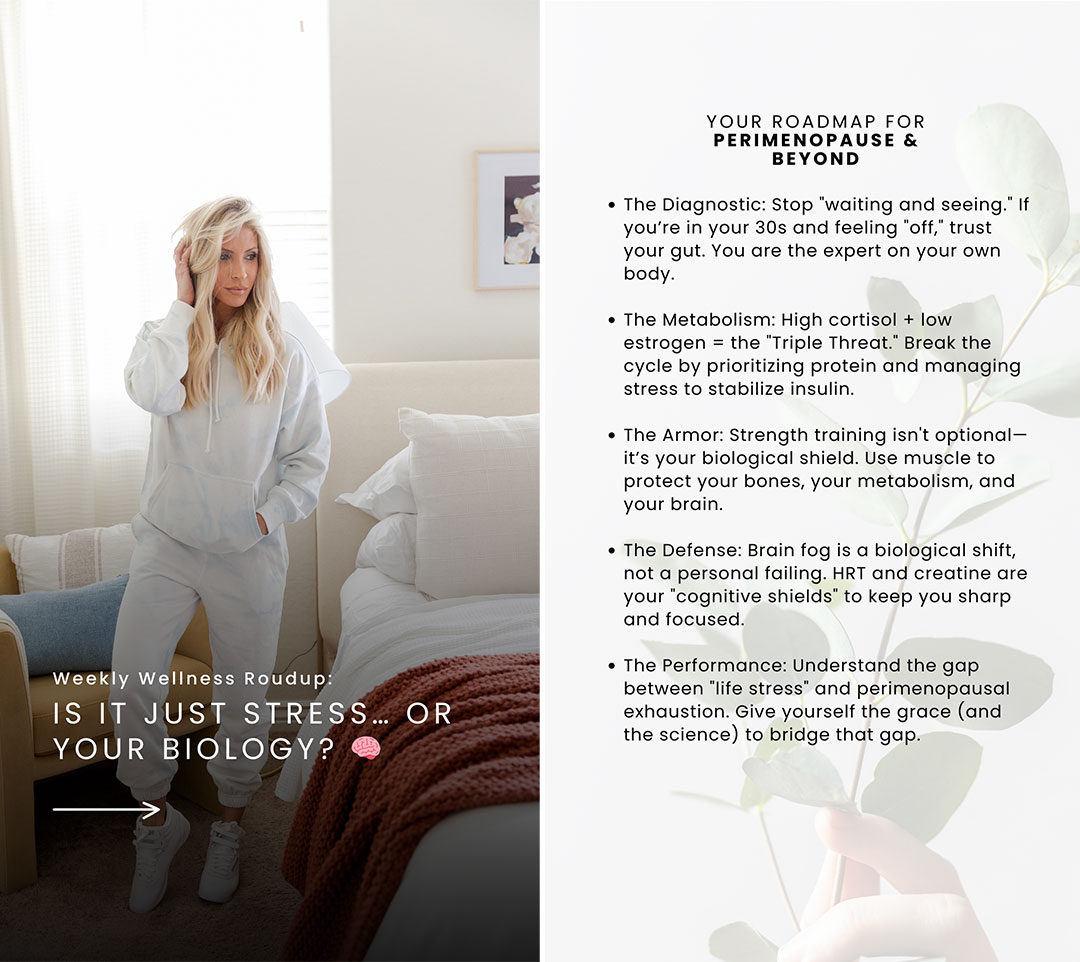
The Symptom-First Diagnostic: Recognizing Perimenopause with a Regular Cycle (aka regular cycle vs. perimenopause symptoms)
Listen, I’ve been there—thinking I’m just “tired” or “overworked” when really, my body was sending me SOS signals. The latest 2026 research is finally catching up to what we’ve felt: Symptoms like night sweats, sleep issues, heart palpitations, and mood swings (those lovely VMS symptoms) often hit way before your period even thinks about changing.
✨ Related: Struggling to catch those Zzs?
Check out our updated guide on [How to Fix Your Sleep During Perimenopause] →
We’re moving away from “wait and see” and toward “act and optimize.” If you’re in your 30s and still have a regular cycle but feel like a stranger in your own skin, you aren’t crazy. It’s perimenopause.
For some women, this stage may last only a few months or continue for 10 years. It’s almost like experiencing puberty again. And for others, their concerns might be dismissed by their healthcare providers as just being a part of “normal” life. I know I said it before, but it’s time we become the CEOs of our own healthcare and not suffer in silence, the frustrating space where many women in past generations found themselves living for decades.
Click here for more of my personal tips on perimenopause and menopause →
Managing Metabolic Intelligence: How Cortisol, Insulin, and Estrogen Drive Midlife Weight Gain
If you’re a woman, you know that hormones can be both a blessing and a curse. If our hormones are out of whack, especially during perimenopause, we’ll experience symptoms that can be both problematic health-wise but also quality of life-wise.
In my own journey—and to simplify alllll the research out there—I focus a lot on cortisol, insulin, and estrogen. It’s important to share my experience with Hormone Replacement Therapy. Scroll down for episodes of my podcast to see conversations about my experience with doctors and experts in the Perimenopause field.
The truth is that I’ve been hesitant and even sometimes scared to talk about hormone replacement therapies because I wanted to promote “natural” methods like diet and exercise. But I’ve come to accept that cortisol + insulin + estrogen can be a “triple threat” to our metabolisms, and specifically our weight in perimenopause and for years to come.
The Metabolic SOS Cycle
How Perimenopause creates the “Triple Threat” to your metabolism.
1. Estrogen Drop
Lower estrogen levels “lock” cell doors, reducing insulin sensitivity.
2. Cortisol Spike
Stress spikes cortisol, triggering the liver to dump glucose into the blood.
3. Insulin Surge
The pancreas pumps out excess insulin to manage the rising sugar levels.
4. Fat Storage
Unused insulin is “parked” as visceral fat (the “Menopause Middle”).
Transformation Tip: Use “Muscle as Armor” to force those cell doors back open!
Scroll down for more info.
Put simply, this “triple threat” cycle can make losing weight and even maintaining a healthy weight tricky from our 30s and beyond, especially when we enter perimenopause. Even if we’re following the most amazing nutrition and exercise routine consistently. Even then.
So, what can you do?
Fuel Your Metabolism: HRT Resources from my podcast:
Deep-dive conversations with leading women’s health experts to help you master your hormones.
Ep. 82: Why “Healthy” Stops Working After 35
Guest: Lauren Douglas, FNP-C | Focus: GLP-1s, Peptides, & Insulin Resistance.
Using Muscle as Armor: The 2026 Science of Strength Training and Creatine for Bone Density
As we age, even as early as in our 30s, we start to lose muscle at a rate of 3-8% per decade and even faster as we near age 60. Our bone density starts to decline in our 30s as well. Lower estrogen levels can contribute to bone and muscle loss and increased fat gain, unfortunately. Regular strength training is one way to maintain and even improve our existing bone density and muscle mass when our hormones are shifting, and spending a few minutes a day a few times a week is a simple way to start now—even in our teens and twenties—to protect and build those bones and muscles before any level of perimenopause sets in.
✨ The 30-Minute Rule: I break down the science of why shorter, high-intensity workouts are superior for perimenopause in my Fitness Action Plan →
Regular strength training not only helps protect our bones and muscles, but it can also boost our metabolism, decrease abdominal fat, decrease risk of injury, improve flexibility and mobility, improve brain health, help us feel better mentally, and more. It also helps build that “mind-muscle connection”—that internal focus as we’re strengthening our muscles—that can actually reduce the risk of dementia and improve our overall quality of life.
Need more? Click here for my guide on how to build muscle after 40
Need some fast + effective strength training workouts? I’ve got you covered!
- Transformation Tip | 5 Minutes to Fight Fat and Get Fit
- 5 Workouts You Can Do Anywhere
- Fit On the Job! 6 Tips + 14 Exercises for the Desk Bound Professional
All of these benefits are what we need to keep us as healthy as possible and enjoying life to the fullest as we move into our 30s and beyond. I’ve learned that strength training can look like walking with a weighted vest (heart-healthy cardio + strength training!) and weighted compound exercises—like my favorite “seven-minute workouts”—that work multiple muscles at the same time! Examples of compound exercises are squats, deadlifts, lunges, rows, hip thrusts, and more!
No dumbbells? Resistance bands are my go-to when I don’t have access to more traditional weights, and they can still get you the results you want.
>> Learn more about creatine and what creatine I use by clicking here <<
Now let’s talk about creatine! Creatine is a new rising star in your all-stages-of-menopause tool kit. I used to think that creatine was only for bodybuilders who wanted to “get big,” but my perspective has definitely shifted.
Creatine can help increase muscle mass, decrease bone density loss, improve brain function and health, reduce fatigue, and potentially decrease the risk of other neurological diseases.
One form of creatine, creatine monohydrate, has been extensively studied as to its effectiveness, and experts recommend taking *3-5g per day. I take 5g of creatine every single day, and I have definitely noticed a difference in both my physical health and brain function!
The Cognitive Defense Era: Preventing Brain Fog and Memory Loss with HRT
Let’s get real about the brain fog. That feeling where you walk into a room and literally cannot remember why? Or…you look in the mirror and you don’t recognize that woman staring back at you who looks exhausted and NOT at all like YOU. I call this “hormonal brain,” which also brings with it random mood changes and just feeling “off.” It is terrifying.
🧠 “Is it just me, or is it my brain?”
Click below for episode on my YouTube channel where I tackle the terrifying reality of perimenopausal brain fog in these must-listen clips:
- [45:55] Why your brain is “running on empty” (Ep. 82)
- [1:08:00] Peptides and memory restoration (Ep. 71)
“You aren’t losing your mind; you’re just navigating a biological shift.”
In the past, we might’ve blamed ourselves and what we’re not doing—or are doing—for these age-related shifts that are not our fault. Like I mentioned, our bodies and our brains start changing in our 30s, so we’ve got to change what we’re doing too. Thankfully, in our “wiser” years, we’re also entering an era where we can view Hormone Replacement Therapy (HRT) as a preventative measure for our brains, because those shifting hormones (especially estrogen) can cause that brain fog, lack of energy, and even negatively affect our brain health.
The Fatigue vs. Exhaustion Gap: Understanding the Impact of Perimenopausal VMS on Performance
Have you ever felt that deep exhaustion—that feeling of being completely wiped out, maybe even “broken”—the type of exhaustion that doesn’t match what’s going on in your life effort-wise? I’m here to tell you that you are not broken.
Perimenopause and menopause often occur during high-stress life transitions—kids leaving for college, job changes, financial changes, and so on, which masks actual exhaustion and fatigue as simply “life stress.” Any symptoms and stage of menopause can be made even more difficult because it occurs during these major life transitions.
🧠 Cognitive Defense & Clearing the Brain Fog
- [Listen at 45:55] Reclaiming your mind from Brain Fog — Understanding why your “brain battery” feels empty.
- Ep. 65: Estrogen & The Vagina Conversation — Deep dive with Dr. Rhadhika Sharma on HRT and sexual health.
⚡ Performance & The Exhaustion Gap
- Navigating Menopause + Weight Loss — My 4-step strategy to bridge the “Performance Gap.”
- 10 Tips for Menopause Survival — Practical daily habits to combat physical fatigue and VMS.
A recent study found that 83% of women over age 35 (who didn’t realize they were in perimenopause) experienced fatigue and exhaustion, not realizing that these are symptoms of perimenopause. Of those who knew they were in perimenopause, those stats jumped to 93% and 95%!
Just to be clear: The study highlighted that exhaustion encompasses “a general decrease in performance, impaired memory, decreased concentration, and forgetfulness,” while fatigue is physical exhaustion, often linked to changing cortisol and insulin levels as well as sleep issues, muscle weakness, “heavy” limbs, slower reflexes, lower immunity, heart palpitations, digestive issues, and general achiness. It’s important to understand that difference since it’s easy to lump fatigue and exhaustion together in the same bucket when they are actually different.
If your “sleep issues” feel more like a permanent state of exhaustion, you aren’t alone. I just updated my deep dive on [mastering your sleep hygiene here] to help you get your energy back.

So, what can you do? Again, speak with a trusted healthcare provider to put a plan in place that can help combat any fatigue and exhaustion you’re feeling. This has been life-changing for me, and I want you to get the life-changing help you need to live your best life too.
In your 30s and beyond? The crucial thing I want you to take away from all the information I’ve shared is that YOU are the CEO of YOUR health. You know what’s best for you. You deserve to be heard. You deserve to get the help you need. And if any healthcare provider “listens” (yes, I meant that sarcastically) to your symptoms and tells you, “That’s just part of getting older,” run, my friends. Run far away.
xo,

Related reading:
It’s Getting HOT in Here || 10 Tips for Menopause Survival
Sleep is Overrated. Not.
Keep It Simple: Health + Nutrition Tips for Everyday Living
Weight Gain During Period: 4 Ways to Combat That Time of the Month
*Please consult with your healthcare team before taking any dietary supplement.
2 Responses
Love this very helpful and informative!
So glad to hear that, Stacey!! ❤️